They cannot see the whole student
An app may detect a correct note while missing harmful tension, poor posture, inefficient movement, uneven breathing, or a weak physical setup.

Francis M. Hale
July 27, 2026
There are more ways to learn music than ever before. A beginner can open an app, watch a YouTube tutorial, buy a video course, download chord charts, or book a live lesson with a music teacher—all without leaving home. The abundance is exciting, but it creates a hard question: what is the best way to learn music online?
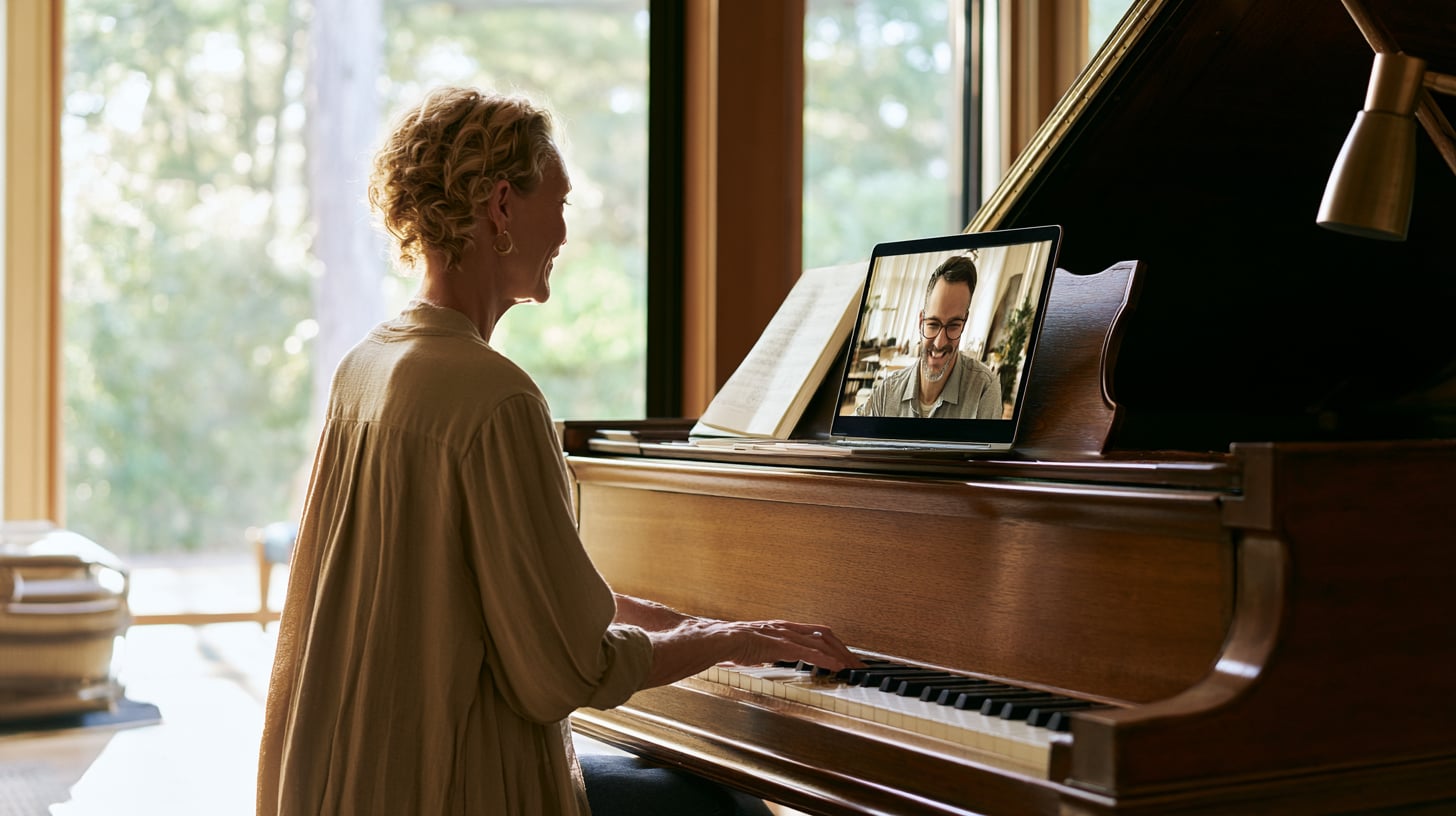
The honest answer is that music-learning apps and live online music lessons solve different problems. An app can provide exercises and repetition. A video can demonstrate a song. A live teacher—an online music tutor—can observe you, diagnose what is happening, and adapt the next step. Understanding that distinction can save months of frustration. For how live lessons work in practice, see our complete guide to online music lessons or browse Craft Music online lessons.
Music apps are designed to deliver content at scale. A live teacher responds to an individual person. An app can tell you which note to play. A teacher can explain why the note sounds tense, why your hand is uncomfortable, how the phrase should breathe, and which exercise will help you play it more naturally.
A video can demonstrate a chord. A teacher can see that your thumb position is preventing the chord from ringing clearly. An app can measure pitch. A singing teacher can hear that you are pushing too much air, tightening your jaw, or imitating a sound that does not fit your natural voice. The issue is not whether technology is useful—it is. The issue is whether the technology understands what the student needs.
| Feature | Apps and prerecorded videos | Live online music lessons |
|---|---|---|
| Learn at any time | Excellent | Depends on scheduling |
| Immediate automated scoring | Often available | Teacher provides human feedback |
| Personalized explanation | Limited | Strong |
| Technique correction | Limited or unavailable | Strong |
| Accountability | Usually low | Strong |
| Emotional encouragement | Minimal | Personal and responsive |
| Repertoire flexibility | Depends on library | Can be customized |
| Creativity and improvisation | Often limited | Can be central |
| Cost | Usually lower | Higher, but individualized (Craft Music online rates are variable and set by each teacher) |
| Teacher relationship | None | Ongoing |
| Help when stuck | Search for another video | Ask immediately |
| Performance or audition prep | Limited | Highly adaptable |
Apps can be excellent tools when used for the right purpose:
These benefits are real. The problem begins when students expect an app to replace all the functions of a thoughtful teacher.
An app may detect a correct note while missing harmful tension, poor posture, inefficient movement, uneven breathing, or a weak physical setup.
Music is not only a sequence of correct pitches. Tone, balance, rhythm, phrasing, articulation, dynamics, emotion, timing, and intention all matter. Automated systems do not experience the music as another person does.
A student may repeat the same passage for weeks without understanding the cause—fingering, coordination, rhythm, tension, an unclear mental image, or practicing too quickly. A teacher can identify the cause and change the strategy.
Most apps move students through a predetermined curriculum. Real students rarely progress in a straight line. A good teacher builds on strengths while addressing gaps—and creates accountability a closed app never will.
Personal diagnosis. The question is not only “Did the student make a mistake?” It is “Why did it happen, and what will help?”
Adaptable explanations. One explanation will not work for every student. A teacher might explain rhythm mathematically, physically, visually, verbally, or by playing it together until it clicks.
A curriculum around real goals. Favorite songs, exams, original music, joining a band, sight-reading, accompanying yourself while singing, jazz improvisation, home recording, auditions, or returning after years away—a teacher connects foundational skills to what actually motivates you.
Musical conversation. Music develops through listening, imitation, response, and shared attention. Improvising together, comparing interpretations, or turning a rough melody into a composition is hard to automate.
An app can teach notes and rhythm. A teacher addresses hand balance, fingering, pedaling, voicing, tension, phrasing, and coordination between the hands.
A tutorial can show chord shapes. A teacher corrects wrist position, string noise, pick angle, tone, rhythm, transitions, and physical efficiency.
Pitch detection can help, but singing involves breath, resonance, articulation, range, interpretation, and vocal health—careful listening and individualized instruction.
Small changes in bow placement, pressure, speed, posture, and left-hand shape dramatically affect the sound. Teacher feedback is especially valuable.
An app can reinforce timing. A teacher assesses grip, rebound, balance, coordination, sound production, and how you move around the kit.
Videos teach software functions. A teacher listens to your actual track, identifies what the arrangement or mix needs, and helps you make artistic decisions.
Want to experiment casually, need a low-cost introduction, enjoy self-directed learning, primarily want drills or song tutorials, or already have strong technique and know how to evaluate yourself.
Are a complete beginner building healthy habits, have been stuck for weeks, want consistent progress and accountability, need complex physical technique or personalized repertoire, are preparing for a performance or audition, want to compose or improvise, are choosing lessons for a child, or have felt discomfort or tension while playing.
You do not have to choose between technology and a teacher. A strong system can use both:
On Craft Music, that hybrid gets practical support: live online lessons with a real teacher, plus Lesson Hub between sessions for goals, shared notes, practice updates, and assignments—so apps and videos support the plan instead of replacing it. Ask the concierge in the bottom right if you want help matching to a teacher.
A live lesson costs more than a subscription because you receive another person’s time, attention, experience, and judgment. Craft Music online lessons are 50 minutes with variable rates set by each teacher—you see the price on their profile before you book.
The value depends on the quality of the match. A skilled teacher can prevent inefficient habits, organize practice, select appropriate material, help you overcome obstacles, maintain motivation, prepare performances, introduce new musical possibilities, and make the process more enjoyable. The cheapest option is not always the most economical: months of unfocused practice can cost more in lost time and discouragement than a well-structured series of lessons.
Craft Music believes technology should expand access to excellent teachers—not remove the human relationship at the center of education. Apps can count repetitions; a teacher can recognize courage. Software can display a score; a teacher can help you understand what the music is trying to express.
Browse teachers yourself on the Craft Music teachers page, or use the concierge in the bottom right to get matched by instrument, goals, schedule, and budget. If the fit is not right, switching teachers is straightforward. Read what students say on our reviews page.
Some students can learn basic concepts through an app, but personalized feedback is usually important for technique, expression, and long-term progress—especially if you want to learn an instrument online with healthy habits from the start.
YouTube is an excellent resource, but videos cannot assess your individual playing or correct problems specific to you. They work best as supplements to live guidance.
Teachers and apps serve different purposes. Teachers provide individual guidance; apps are useful for repetition and supplemental practice. For most beginners and anyone stuck, a music app vs music teacher comparison favors a live tutor for technique and accountability.
Yes. Apps can reinforce concepts your teacher assigns and help build a consistent practice habit. On Craft Music, keep the real plan in Lesson Hub so drills support clear weekly goals.
A combination of live instruction, deliberate practice, appropriate repertoire, and useful digital tools is generally more effective than relying on a single resource.
Online lessons are 50 minutes with variable rates set by each teacher—check the price on their profile before booking. Book a teacher, or ask the concierge in the bottom right to match you by instrument, goals, and budget.
Browse Craft Music’s online teachers and find a professional musician who can help you move forward—or open the concierge in the bottom right to get matched.
Browse online music lessons Meet Craft Music teachers Read the online lessons guide Read reviewsAt Craft Music, we believe music is an expressive language and a creative outlet. It shapes culture and identity, and we're here to inspire and support your musical and personal growth!


Need Support?
admin@craft-music.com© Copyright 2026 Craft Music. All Rights Reserved. Various trademarks held by their respective owners.