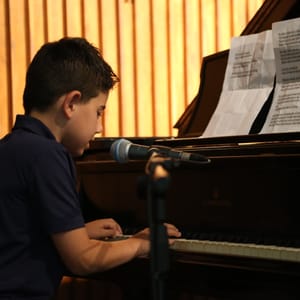
You have mastered the beginner songs. You can play hands together comfortably, you can read notation in both clefs, and simple pop songs are no longer a challenge. What now? The intermediate level is where piano gets really interesting: real classical repertoire opens up, jazz standards become playable, and film music you love starts to feel achievable. This guide lists 15 of the best intermediate piano pieces, organized by style, so you always know what to learn next.
If you are still working through beginner material, our companion article easy piano songs for beginners has the earlier repertoire covered. For a broader view of piano progression, see our how long to learn a musical instrument guide, which covers the piano timeline in detail.
What “Intermediate” Actually Means at Piano
The word intermediate gets used loosely, so here is the honest definition. You are at intermediate piano level if you can:
- Play hands-together comfortably at moderate tempos
- Read both treble and bass clefs fluently
- Play pieces with multiple key signatures (up to 3 or 4 sharps or flats)
- Use the sustain pedal comfortably
- Handle basic voice-leading between chords
- Understand basic music theory including scales, chords, and intervals
If you can do most of the items above, you are ready for everything on this list. If you are still shaky on hands-together or bass clef reading, spend a few more months on beginner material first. Rushing to intermediate repertoire without the technical foundation leads to frustration and slower long-term progress.
Each piece below includes a recommended listening link—benchmark performances from major artists and official recordings so you can hear the goal before you practice.
Classical Intermediate Pieces
- “Für Elise” by Beethoven (opening section). The most-recognized classical piano piece in the world. The A section is intermediate; the middle section is more advanced. Listen: Lang Lang.
- “Minuet in G” (BWV Anh. 114) attributed to Bach (actually by Petzold). Classic Baroque piece, perfect for developing hand independence. Listen: Daniil Trifonov.
- “Prelude in C major” by Bach (Book 1 of the Well-Tempered Clavier). Simple, meditative, and a wonderful introduction to Baroque style. Listen: Glenn Gould.
- Chopin’s “Prelude in E minor” (Op. 28 No. 4). Short, expressive, and deeply satisfying to play. Listen: Seong-Jin Cho.
- Satie’s “Gymnopédie No. 1”. Sparse, elegant, atmospheric. One of the most calming pieces in the classical repertoire. Listen: Aldo Ciccolini.
- Clementi Sonatina in C major (Op. 36 No. 1). The classic first sonatina, standard in every piano curriculum. Listen: Cory Hall.
- Debussy’s “Arabesque No. 1”. Slightly beyond early intermediate, but reachable with focused practice. Listen: Menahem Pressler.
How to Approach Learning These Pieces
Learning intermediate pieces the right way is very different from learning beginner songs. At this level, careful practice separates good progress from slow progress. Our full how to practice music effectively guide covers this in detail. The core principles for intermediate piano:
- Isolate difficult passages. Do not practice a piece start-to-finish for the first two weeks. Identify the two or three hardest sections and drill those.
- Practice hands separately before hands together. Even intermediate pieces benefit from this at the start.
- Use a metronome for at least half of your practice time. Steady tempo is the difference between music and noodling.
- Slow practice is fast practice. Play slowly enough to make no mistakes for a week before speeding up.
- Memorize progressively. Learn from the sheet music, then memorize 4-bar sections at a time.
On Craft Music, keep the weekly focus, assignments, and practice notes in Lesson Hub so you and your teacher stay aligned between lessons—especially helpful when you are rotating two or three pieces at once.
How to Choose Which Intermediate Piece to Learn Next
Fifteen pieces is a lot, and you should not try to learn all of them at once. A working intermediate curriculum usually rotates two to three pieces at a time: one classical, one contemporary or jazz, and (optionally) one etude or technical study. That mix keeps motivation high while building broad musicianship.
When picking what to start next, honestly evaluate what feels hardest right now. Weak left hand? Try something with independent bass patterns like the Bach Prelude in C. Unsteady rhythm? Pick something metronomic like the Clementi Sonatina. Rough pedaling? Choose something pedal-heavy like Satie or Yiruma. Choose the piece that challenges your weakness—not the one that shows off your strength. That is how intermediate students become advanced students.
Where Intermediate Piano Study Goes From Here
Once you have several intermediate pieces polished and memorized, natural next steps include more complex classical repertoire (Chopin nocturnes, Debussy preludes, Beethoven sonata movements), deeper jazz work (walking bass, chord substitutions, Real Book standards), or specialized study in film scoring or composition. A working piano teacher can guide the transition based on your interests.
Browse the Craft Music teachers page, start at Find My Teacher, or ask the concierge in the bottom right for a match. Lessons are available in-home in LA, SF, and Portland, or online nationwide (50 minutes, with variable rates set by each teacher).