
Courses/Guitar

Mastering Any Song that Doesn't Change Key

- Studies the seven chords that are fundamental to every key, giving a feeling of predicting the future, just as long as the song doesn't change key. - Understanding small mistakes that beginners are often self-conscious about but really don't matter to the audience. In other words, a beginner thinks "I must play C Major chord" while an expert realizes everything has a name, and Cmaj7, Cadd2, C5 and Cadd4 are all very similar to C major.
2 lessons· 6m· Beginner
Mastering Any Song that Doesn't Change Key

Who it's for

Ideal for songwriters and improvisers. Also ideal for those with very long set lists that want to be able to remember a long list of chord progressions in an easier way.

Prerequisites

Muscle memorizing famous chords before hand is highly recommend, so that you can play chords in a reasonable amount of time, however, it is not required.

Equipment

Any Guitar

Practice time

15 minutes a week but ideally more. Video is 6m.

About this course

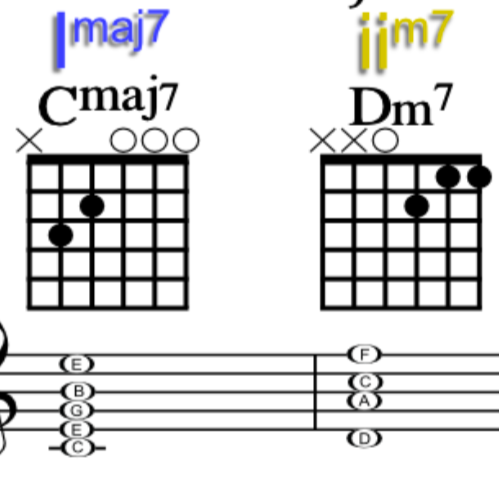
A 12 page PDF that explains the chords that naturally happen (diatonic) in that key. Perhaps analogous to a book writer studying grammar, a musician can study the grammar of chord progressions. That way when a strange chord does happen, you will know it is special, though there are many advantages to studying this. 1. C Major chords (small and large voicings) 2. A minor chords (small and large voicings) 3. A Harmonic minor 4. A minor (Jazz 7ths) 5. A minor (Extreme Jazz extensions) 6. The seven modes This is a songwriting/composition/theory aid designed specifically for guitar. Many music theory books seem abstract and impractical whereas these chord charts show music theory applied to guitar. The aim is to memorize them so that you can understand them in all 12 keys. This collection of PDFs is something I am very proud of and I believe it has been my most well received PDF upload on the internet. Finding chord charts that simply list chords are common. It is much rarer for a chord sheet to try to explain what order they go in and even rarer still to find it for guitar. It's difficult because it is an art, and of course there really is no wrong answers in composing (especially on Halloween I always joke). I personally haven't seen anything else quite like this on the internet. Tips: 1. I find sheets like this to be excellent practice to play by ear. If the music is relaxing I play blue chords, if it is intense I play red chords. Once you get into the groove, and you know no one is changing key, it's as simple as that. 2. When playing by ear, even if you get the exact chord wrong but you still get the correct color, it will still sound like you harmonizing the song correctly!!! See chords categorized by purpose rather than name will elegantly simplify how music actually works. 3. The reason why we study the roman numerals is to be able to think about all of music in a single keyless key to allow for optimum clarity. 4. One issue that needs to be fixed: what to do about the 11 other keys? One easy and quick fix is to use a guitar capo (or downtune) to get to all the other keys. I can't imagine giving out 56 pages of chord progressions to each of my students, it's way too much. Instead, I teach strategies on how these work in all 12 keys. 5. Order = Blue, Yellow, Red, Blue for stereotypical chord progressions that truely progress. There is such a thing as a chord succession where it is not the previous order. Again, try not to see music in terms of right and wrong. Everything expresses an emotion. For example, if there is a song devoid of red chords, it will result in more peaceful nonchalant music. Lots of red would be great for metal music, etc... 6. Use a capo to instantly transfer these to any key you want. It takes some practice to make transpositions. An example is: say you want the key of B minor but the first chord on the sheet is A minor. Answer: Capo on fret 2 in order to transpose up two half steps. 

Curriculum

Preview free lessons, then enrol to unlock the full practice path.

Chords Every Guitarist Should Learn First

If you master these chords, you will be easily able to play a song that doesn't change key, especially when using a capo. The gist is this: the internet is filled with sites that show thousands of guitar chords, and it can fill like drinking information from a fire hose. Very few sites explain what chord should happen next, which is what this lesson is primarily about, along with many other tips and tricks.

  • Freedom as a Rhythm Guitarist
    Preview 2:45
  • Tension and resolution
    Preview 3:42

What you can download

These files unlock when you enrol.

  • All Chord Progression Generators.pdf

    3.5 MB

  • Blank Guitar Sheet - TAB_Traditional_Chord_Diagram_ Scale_Diagram.pdf

    13.5 MB